

Career and Education advice
- 26 January 2026
- 75 views
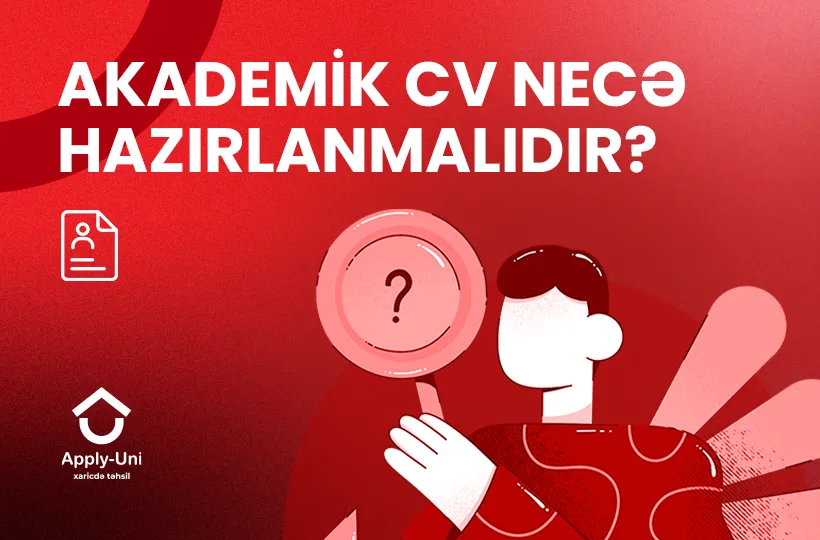
How Should an Academic CV Be Prepared?
CVs submitted for bachelor’s, master’s and PhD applications differ significantly from those prepared for job applications. Their main purpose is to demonstrate the applicant’s suitability for an academic environment. Through this document, universities assess not only where the applicant has studied, but also their learning ability, academic potential and future development prospects. Therefore, a CV prepared for university applications should primarily focus on education, academic activities and intellectual skills.
The length of the CV depends on the level of study being applied for. For bachelor’s applications, the CV is usually one page long; for master’s applications, one to two pages; and for PhD applications, two to four pages. The key principle is not to shorten the CV artificially, but to include only information that adds value to the specific programme being applied for.
A university CV begins with basic personal information such as name, surname, a professional email address and the city of residence. This is followed by educational background, which is considered the most important part of the CV. Education should always be listed in reverse chronological order. Information about secondary school or college is particularly important for bachelor’s applications, while for master’s and PhD applications, university education, field of study, grade point average and thesis or final project take priority.
For bachelor’s applications, the CV is generally simpler and mainly reflects academic performance. This may include school achievements, olympiads, certificates, volunteer activities, participation in projects and academic interests. Work experience is not a primary requirement at this stage; however, activities that demonstrate responsibility and a willingness to learn are considered an advantage.
For master’s and PhD applications, research experience plays a much more important role. Course projects, final theses, research-oriented assignments and academic projects are key components of these CVs. In PhD applications, clearly stating the dissertation topic, research interests and methodologies used helps to demonstrate the applicant’s academic potential. If the applicant has publications, conference presentations or other academic outputs, these should обязательно be included.
In the academic skills section, it is important to avoid generic and clichéd expressions. Research skills, analytical thinking, academic writing experience, as well as relevant software and methodological knowledge should be presented clearly and specifically. Descriptors such as “responsible” or “communicative” weaken a CV if they are not supported by concrete examples.
Language skills are an important part of university applications and should be stated honestly and accurately. Where possible, international language certificates should be included, and language levels should not be exaggerated. Work experience should only be added if it is relevant to academic or educational goals. Jobs unrelated to the academic field should be mentioned briefly only if they contributed to the development of relevant skills.
References also play an important role in university CVs. For bachelor’s applications, school teachers may act as referees, while for master’s and PhD applications, academic supervisors or university lecturers are more appropriate. The presence of referees makes the CV appear more serious and credible.
For detailed information:
WhatsApp: +99410-527-10-40 / +99470-527-10-40
İnstagram: Apply_Uni
Share Post:


CVs submitted for bachelor’s, master’s and PhD applications differ significantly from those prepared for job applications. Their main purpose is to demonstrate the applicant’s suitability for an academic environment. Through this document, universities assess not only where the applicant has studied, but also their learning ability, academic potential and future development prospects. Therefore, a CV prepared for university applications should primarily focus on education, academic activities and intellectual skills.
The length of the CV depends on the level of study being applied for. For bachelor’s applications, the CV is usually one page long; for master’s applications, one to two pages; and for PhD applications, two to four pages. The key principle is not to shorten the CV artificially, but to include only information that adds value to the specific programme being applied for.
A university CV begins with basic personal information such as name, surname, a professional email address and the city of residence. This is followed by educational background, which is considered the most important part of the CV. Education should always be listed in reverse chronological order. Information about secondary school or college is particularly important for bachelor’s applications, while for master’s and PhD applications, university education, field of study, grade point average and thesis or final project take priority.
For bachelor’s applications, the CV is generally simpler and mainly reflects academic performance. This may include school achievements, olympiads, certificates, volunteer activities, participation in projects and academic interests. Work experience is not a primary requirement at this stage; however, activities that demonstrate responsibility and a willingness to learn are considered an advantage.
For master’s and PhD applications, research experience plays a much more important role. Course projects, final theses, research-oriented assignments and academic projects are key components of these CVs. In PhD applications, clearly stating the dissertation topic, research interests and methodologies used helps to demonstrate the applicant’s academic potential. If the applicant has publications, conference presentations or other academic outputs, these should обязательно be included.
In the academic skills section, it is important to avoid generic and clichéd expressions. Research skills, analytical thinking, academic writing experience, as well as relevant software and methodological knowledge should be presented clearly and specifically. Descriptors such as “responsible” or “communicative” weaken a CV if they are not supported by concrete examples.
Language skills are an important part of university applications and should be stated honestly and accurately. Where possible, international language certificates should be included, and language levels should not be exaggerated. Work experience should only be added if it is relevant to academic or educational goals. Jobs unrelated to the academic field should be mentioned briefly only if they contributed to the development of relevant skills.
References also play an important role in university CVs. For bachelor’s applications, school teachers may act as referees, while for master’s and PhD applications, academic supervisors or university lecturers are more appropriate. The presence of referees makes the CV appear more serious and credible.
For detailed information:
WhatsApp: +99410-527-10-40 / +99470-527-10-40
İnstagram: Apply_Uni
Share Post:
Leave A Comment
Your email address will not be published. Required fields are marked *